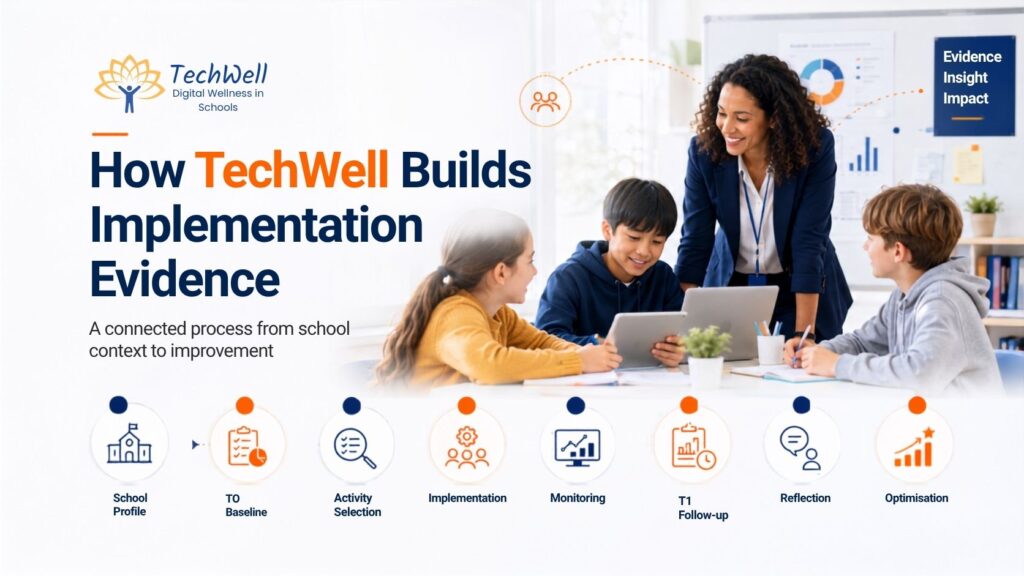
As TechWell moves from development towards real-school implementation, the project is entering a phase where structured evidence becomes increasingly important.
The pilot is designed not as a series of isolated activities, but as a connected implementation journey. Across participating countries, schools follow a shared sequence: school profiling, baseline assessment, activity selection, implementation, monitoring, follow-up assessment, reflection and optimisation.
This common structure helps the consortium understand not only whether change occurs, but also how implementation works in different educational contexts.
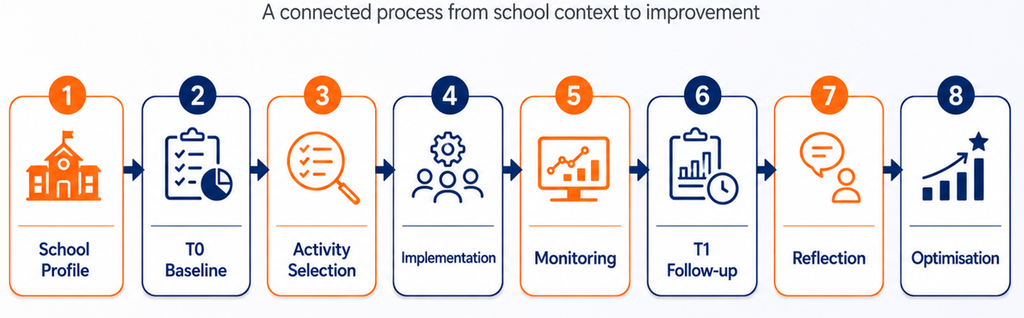
TechWell implementation evidence pathway: from school profile and baseline assessment to reflection and optimisation.
A connected process from context to improvement
Every participating school starts from a different position. Schools vary in size, location, digital infrastructure, institutional culture, available support structures and previous experience with digital wellbeing.
For this reason, the pilot begins with school profiling. The purpose is not to select only highly prepared institutions, but to build a diverse and realistic pilot cohort and to understand the conditions in which implementation takes place.
This contextual information forms an important part of the evidence process, helping national partners interpret later findings more accurately.
Establishing the baseline before implementation
Before the core Digital Wellbeing Suite activities begin, participating schools complete a baseline assessment, referred to as T0.
Depending on the local context, this may include short questionnaires for students and teachers, input from school leadership, and a mapping of existing rules, practices and support structures related to digital wellbeing.
The aim is to establish a meaningful starting point while keeping the process proportionate and avoiding unnecessary administrative burden for schools.
Flexible implementation, shared evidence
One of the key principles of the TechWell pilot is that schools do not need to deliver identical activities in exactly the same way.
Teachers and schools may adapt selected activities to their curriculum, language, learners and timetable. This flexibility is essential for ensuring that the Digital Wellbeing Suite remains practical and relevant in different national and school contexts.
At the same time, cross-country learning depends on a shared evidence framework. Comparability is supported through common thematic outcomes, agreed indicators, documented implementation and a consistent evidence chain.
In this way, the project combines local flexibility with a common structure for learning across countries.
Monitoring implementation in real school settings
Evidence collection continues throughout implementation.
National partners monitor participation, adaptations, contextual factors and practical challenges that emerge during the pilot. This makes it possible to distinguish between issues related to local conditions and areas where the Digital Wellbeing Suite itself may require refinement.
Monitoring is therefore not only about documenting what happened. It also provides a basis for timely support during implementation and for improving the overall approach.
From follow-up assessment to optimisation
The evidence process continues after implementation through follow-up assessment, or T1, and structured reflection.
By comparing the starting point with implementation experience and follow-up findings, the project can better understand what worked, what required adaptation and where further development may be needed.
The goal is not simply to report that activities were completed. It is to generate practical, evidence-based recommendations that can strengthen the Digital Wellbeing Suite and support its future use by schools, education professionals and policymakers.
As the pilot phase progresses across participating countries, this connected evidence process will help TechWell turn real-school experience into learning for future implementation.
Explore the Digital Wellbeing Suite:
https://techwellproject.eu/digital-wellbeing-suite/
Explore the educational materials:
https://techwellproject.eu/educational-materials/